
Most companies treat churn like a customer problem. But churn is usually an operating problem, with unclear ownership, weak follow-up, and invisible risk signals.
Fix the operating system behind retention, and you don’t just reduce churn. You make customer loyalty easier to deliver consistently.
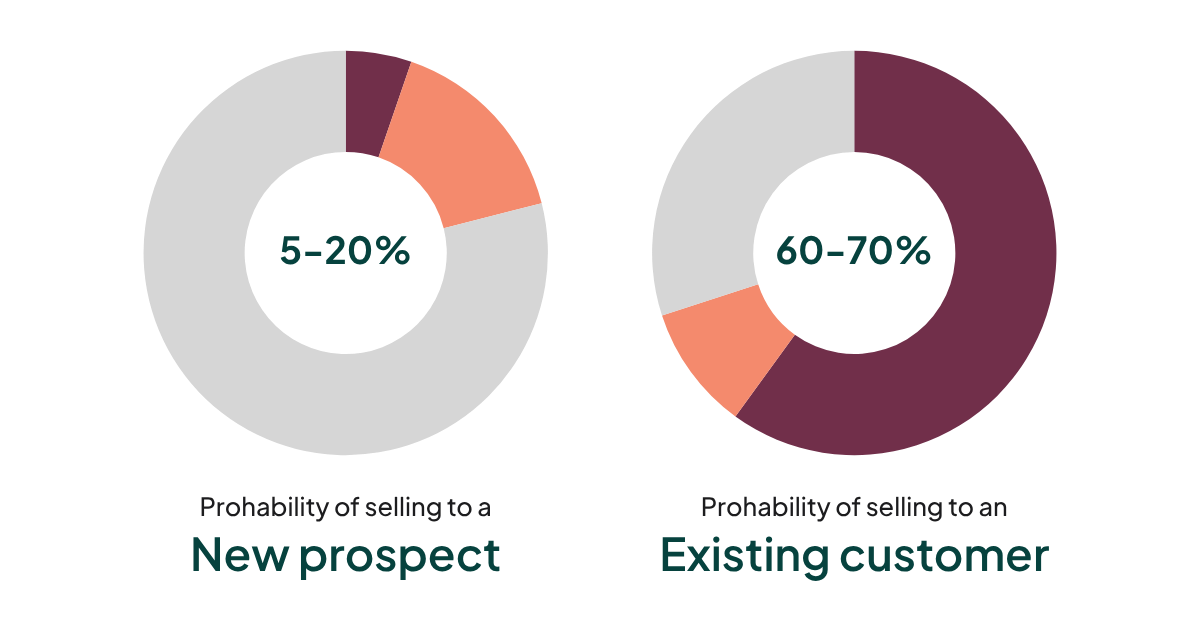
Replacing churn is expensive. Harvard Business Review notes that acquiring a new customer is anywhere from five to 25 times more expensive than retaining an existing one.
Even small retention gains compound. Bain & Company has long argued that a 5% increase in retention can boost profits by as much as 95% (depending on industry and margins).
The problem: Customers leave quietly, and you only notice when revenue drops.
The solution: Build a simple retention system that spots risk early and proves value often.
The proof: Even small improvements in retention can lift profitability because keeping customers is typically cheaper than replacing them.
What is customer churn, and why does it matter?
Customer churn is the percentage of customers who stop doing business with you over a specific period.
Churn rate = (Customers lost during the period ÷ Customers at the start) × 100
You can have a good product and still lose customers if the experience around it is inconsistent.
Churn matters because it hits you in three places at once:
- Revenue and forecasting: growth slows, and planning becomes guesswork.
- Efficiency: your team spends time replacing customers instead of compounding value.
- Trust: churn signals gaps in onboarding, service quality, or expectation-setting.
If you want sustainable growth, you need a plan to prevent churn, not just react to cancellations.
The real reason churn keeps happening
Churn prevention fails when it depends on memory.
If your team can’t easily answer “Who is at risk?” and “Who owns the next step?”, you will always be late.
Retention becomes easier when your process is visible, repeatable, and owned.
1. Analyse why churn happens
The first step in reducing churn? Understand it.
You can’t fix churn if you don’t know what triggers it.
Many teams assume customers leave because of price, when the real cause is often friction, confusion, or slow resolution.
Start with two simple habits:
- Call (when possible) instead of only surveying. A short conversation gives you context you’ll never get from a rating.
- Standardise your churn reasons. Don’t accept “not a fit” as a final answer. Break it down.
Monitor sentiment across the places customers already talk to you:
- Email and support interactions
- Website behaviour and NPS responses.
- Live chat transcripts (/blog/live-chat-support-study/)
- Social mentions and community feedback
When these signals live in separate tools, patterns stay invisible.
Pro tip: Store churn reasons as structured fields (not just notes). That makes it possible to report, prioritise fixes, and track improvement over time.
2. Engage with your customers before they need to ask
Customer relationships aren’t won at the point of sale.
They’re built in the months after, when customers are trying to get value with limited time and attention.
You reduce churn by staying present in ways that feel useful, not noisy:
- Share short, practical tips tied to the outcome they bought
- Communicate changes that affect planning (maintenance, updates, timelines)
- Run proactive check-ins with a clear purpose (“Are you getting the result you expected?”)
Proactive touchpoints work best when you solve small issues before they become big ones. That’s the difference between reactive support and proactive support, and it’s one of the simplest ways to reduce churn without discounting.
This is the heart of relationship marketing.
Personalisation matters here but keep it respectful.
Use context your customer expects you to know, like lifecycle stage, current goals, and recent support themes.
3. Educate the customers so they feel confident
Customers rarely churn because they “hate” your product.
They churn because they don’t feel confident it’s delivering enough value for the effort required.
Education reduces uncertainty and prevents avoidable support loops.
Build education around the moments customers typically get stuck:
- Onboarding steps and first success milestone
- Common setup decisions
- Reporting and stakeholder updates
- Feature adoption that changes workflows
Offer multiple formats so customers can choose what fits:
- Short walkthrough videos enchanced with text to video AI
- Webinars (live and on-demand)
- Knowledge base articles
- Office hours / Q&A sessions
Pro tip: Track which education content customers consume. If many customers drop off at the same step, you’ve found a retention leak.
4. Know who’s at risk before they leave
Churn is often visible weeks before it happens.
Watch for behaviour changes that signal lower confidence or lower engagement:
- Drop in usage or logins
- Unresolved support tickets
- Late invoice payments
- Fewer responses to outreach
- Missed check-ins or success milestones
Acting early is measurable. McKinsey found that an analytics-driven approach can reduce churn by as much as 15% in mature churn programmes.
The key is acting early, while trust is still recoverable.
That requires two things
- a consistent way to spot risk, and
- a reliable way to assign ownership.
When risk is visible and ownership is clear, outreach becomes proactive instead of apologetic.
A CRM helps you identify at-risk customers by tracking engagement trends across sales, service, and marketing. You can set up alerts based on inactivity, overdue follow-ups, or negative support sentiment, so your team can act while there’s still time to rebuild trust.

Turn churn signals into a retention routine
Risk signals only help if they trigger action.
Use customer retention tips with CRM software to turn early warning signs into a repeatable process: who owns the account, what happens next, and how you track whether the risk is reduced.
You can also book a free demo if you want to see the workflow end-to-end.
5. Define your most valuable customers
Not all churn is equal.
Losing a low-fit customer who never adopted your product is not the same as losing a high-value customer who trusted you for years.
You reduce churn profitably when you prioritise retention based on:
- Revenue or margin contribution
- Expansion potential
- Strategic importance (reference value, partnerships, long-term fit)
- Advocacy and influence inside their organisation
You’re not trying to treat everyone the same, you’re trying to give the right customers the right level of attention, at the right time.
Segmenting your customer base by value, loyalty, or expansion potential allows you to direct your time and resources toward the relationships that truly drive your business forward.
Gartner found that just 20% of your customers account for 80% of your future revenue. You can’t afford to treat every customer the same.
6. Offer incentives, but don’t train customers to wait for discounts
Incentives can work, but only when they reinforce value.
If discounts become your default, you teach customers your price is flexible and your value is negotiable.
Use incentives strategically:
- Reward loyalty (renewal perks, priority access)
- Drive adoption (training credits, implementation support)
- Re-engage inactivity (time-limited upgrade trials)
- Create shared wins (referrals, feedback, case studies)
Your goal isn’t to “buy” retention.
Your goal is to remove barriers while reinforcing the customer’s path to success.
7. Target the right audience from the start
Retention begins with acquisition.
If you win customers who are a poor fit, you’ll spend the relationship fighting churn.
Ask yourself:
- Are you selling on value or price?
- Are expectations aligned with what you deliver?
- Are you qualifying for long-term fit, not just initial interest?
This is why your Ideal Customer Profile (ICP) matters.
A strong ICP reduces churn because customers arrive with a real use case and realistic expectations.
8. Give better service, not just faster service
Great products win deals.
Great service keeps customers.
Customers churn when service feels like:
- Slow responses
- Repeated handovers
- “Tell us again” conversations
- Unclear ownership
- Fixes without follow-up
Service failures don’t just frustrate people, they trigger switching. Zendesk Benchmark data says more than 50% of consumers will switch after only one bad experience, and 73% will switch after multiple bad experiences.
Better service means:
- Fast and helpful responses
- Consistency across channels
- Empathy and clear ownership
- Proactive follow-up to confirm the outcome
Service is only one part of retention. Customers stay when the entire journey feels consistent, onboarding, support, and success reviews included. That’s why a clear customer experience strategy is often the fastest way to remove churn-causing friction.
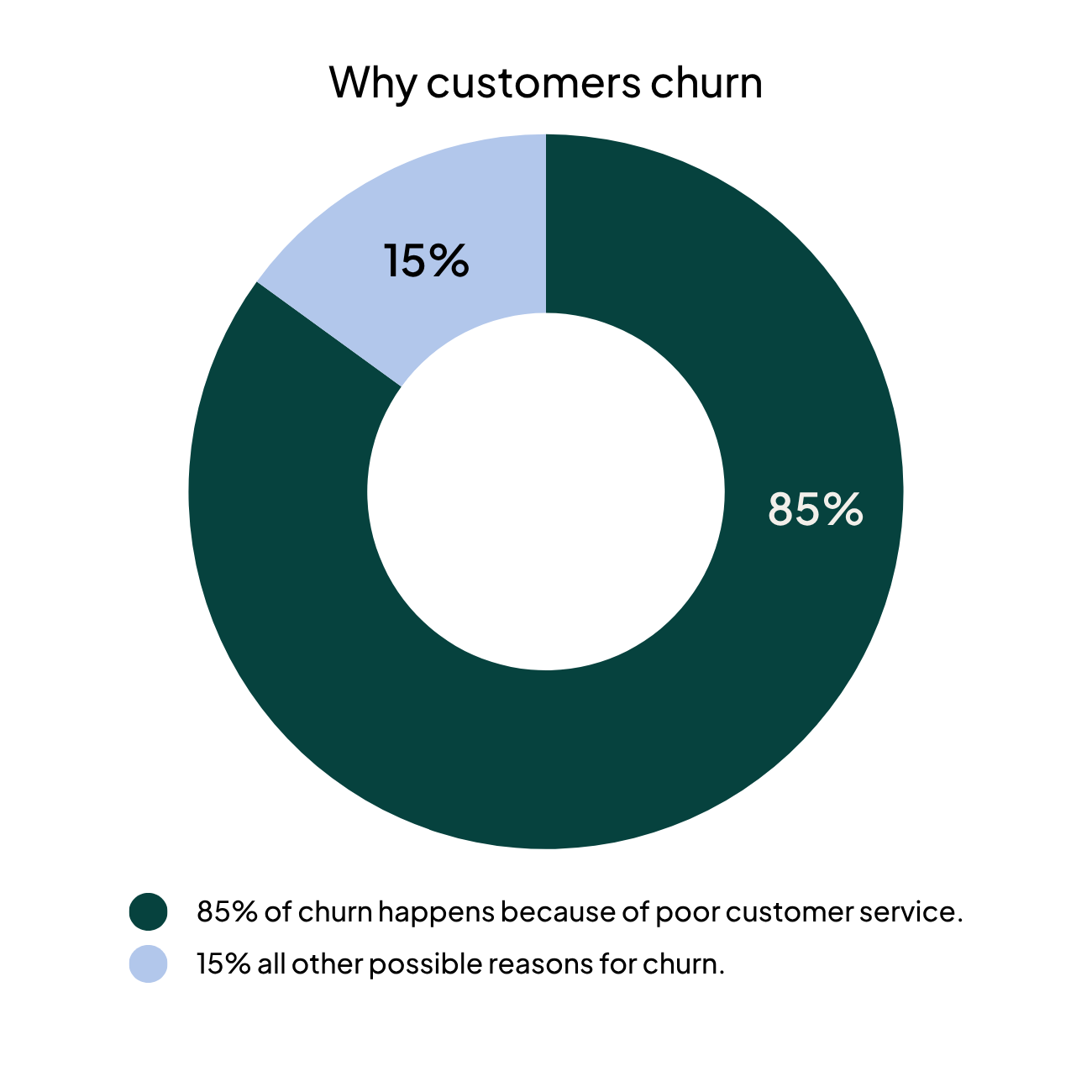
Research shows that 85% of churn is due to poor service, not price or product. That’s a huge opportunity to differentiate.
If service is driving churn, improve the end-to-end experience, not just ticket speed. Customer service and customer retention breaks down what keeps customers from leaving.
When you want to see how this works in your day-to-day operations, explore Service.
9. Pay attention to complaints (they’re early warning signs)
Complaints are not the problem. Silence is.
Most unhappy customers don’t complain loudly, they disengage quietly.
Silence is a risk signal. Zendesk reports that 56% of consumers rarely complain about a negative experience, they quietly switch instead.
Turn complaints into a retention advantage:
- Make feedback easy to give (in-product, follow-up emails, success calls)
- Categorise complaints (product, onboarding, support, expectation gap)
- Close the loop (“We heard you. Here’s what we changed.”)
If you want a deeper behaviour angle: Why customer complaints are good for business.
10. Make your best people on cancellation conversations
A cancellation request is not admin work.
It’s a high-value conversation at the most emotionally loaded moment in the relationship.
Your best retention conversations come from people who can:
- Listen without defending
- Diagnose the root cause quickly
- Propose a realistic path forward
- Protect trust, even if the customer still leaves
Don’t rely on a single “sorry to see you go” message. A structured follow-up email can recover context, reopen the conversation, and create a clean next step, even when the customer isn’t ready to talk live.
If you treat churn like paperwork, you lose insight and you lose options.
If you treat churn like learning, your retention improves quarter by quarter.
11. Reinforce your competitive advantages
Customers don’t always leave because a competitor is better.
They leave because your value becomes less visible.
That happens when wins aren’t measured, outcomes aren’t shared, and stakeholders change without a handover.
Make value concrete:
- Show adoption and progress since onboarding
- Summarise outcomes in plain language
- Remind them why your approach fits how they work
- Share proof during regular success reviews
Retention improves when customers can see the value without doing detective work.
12. Offer long-term contracts (when the timing is right)
Long-term contracts can reduce churn, but only when trust already exists.
Contract structure influences retention. SaaS Capital’s B2B SaaS Retention Benchmarks report that companies using multi-year contracts show higher median retention, supporting the idea that longer commitments can reduce churn when trust is already there.
The wrong time to offer a long-term deal is when the customer is uncertain.
The right time is after they’ve seen success and agreed internally that the solution works.
Use long-term contracts to create mutual value:
- Price stability for the customer
- Predictable revenue for you
- Shared commitment to outcomes
Retention isn’t about pressure.
It’s about helping the customer confidently say: “This is working.”
A simple weekly churn prevention system you can run
If you want this article to change outcomes, you need a routine.
Here’s a weekly system most B2B teams can run in 30–45 minutes.
Step 1: Review risk signals
Pick 3–5 signals you can track consistently:
- Engagement drop
- Unresolved issues
- Renewal date proximity
- Stakeholder change
- Negative feedback trend
Step 2: Assign ownership
Every at-risk account gets:
- One owner
- One next action
- One deadline
No owner means no follow-up.
If retention actions live in spreadsheets or people’s heads, they don’t scale. Build simple workflows so follow-ups are assigned, timed, and tracked the same way every week.
Step 3: Act with value
Outreach should be specific:
- “I saw X changed, can we align on next steps?”
- “You haven’t reached Y milestone yet, want help getting there?”
- “Issue Z is recurring, here’s what we’re changing.”
Step 4: Capture the outcome
Log:
- What triggered the risk
- What action you took
- What outcome happened
- What you learned
Over time, that becomes your retention playbook.
Pro tip: This is where a CRM platform should help in a practical way, with one customer record, visible ownership, and follow-ups that don’t rely on memory.
Quick churn self-audit: where are your risks?
Answer Yes / No:
- Do you know which accounts are at risk this month?
- Do you have one owner per account for retention follow-ups?
- Can you see unresolved issues across channels in one place?
- Do customers reach first value in the first 30–90 days?
- Do you run success reviews before renewal cycles?
- Do you track churn reasons in a way you can report on?
- Do you segment customers by value and retention priority?
- Do you have a repeatable win-back process?
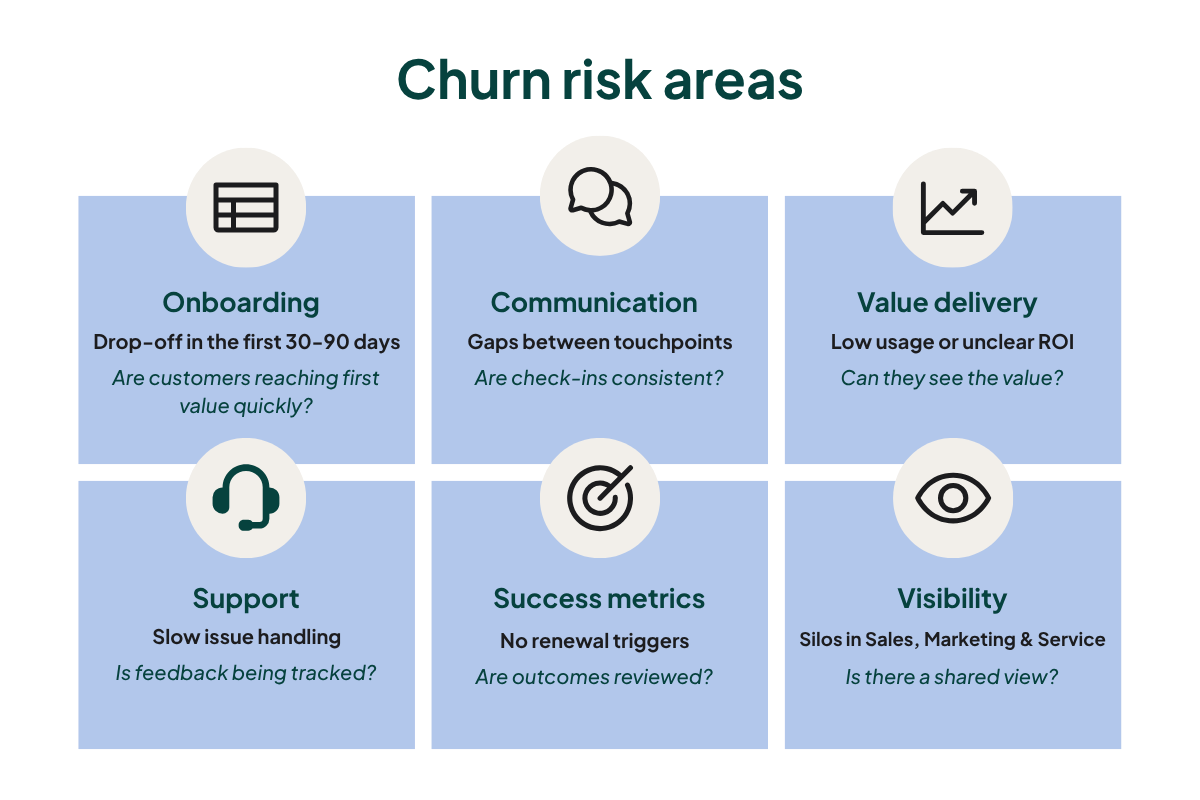
If you answered “No” more than once, you don’t need more tactics.
You need more visibility and clearer ownership.
Stop churn by making retention easy to run
Churn doesn’t drop because your team “tries harder”. It drops when follow-up becomes predictable, with clear signals, clear ownership, and timely actions before renewal risk turns into cancellation.
If you want a practical next step, read customer retention tips with CRM software and copy the routines that make retention easier to run.
If retention depends on handovers between teams, make sure everyone works from the same customer record, from first deal to support to renewal.
When you’re ready to see how churn signals turn into follow-ups inside one workflow, get a guided churn-risk walkthrough.
FAQ: Customer churn and retention
It depends on your model, contract length, and customer segment. The useful question is whether churn is trending down and whether you can explain the changes.
Reduced engagement, unresolved issues, stakeholder changes, and missed success milestones are common signals. The best signal is one you can track consistently and act on fast.
Run a weekly retention routine, make ownership visible, and fix one repeated friction point. Most churn projects fail because they stay theoretical.
A CRM helps when it makes the work easier: one customer view, clear ownership, timed follow-ups, and retention reporting that shows what’s changing.
Sometimes, but only when tied to a success plan. Discounts without adoption and outcomes can reduce trust and train customers to wait.


